

german version below
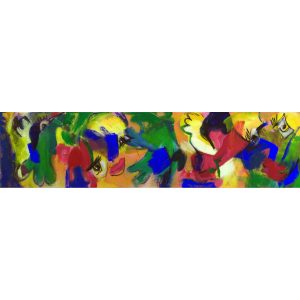
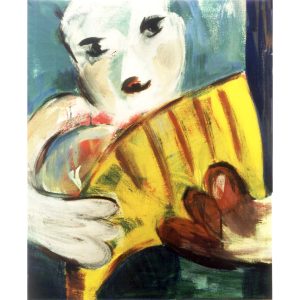
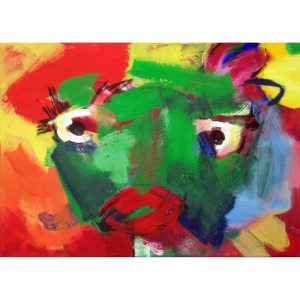
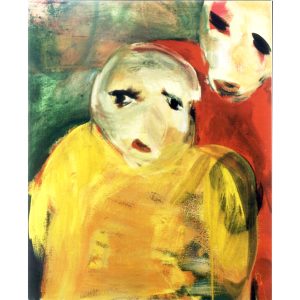
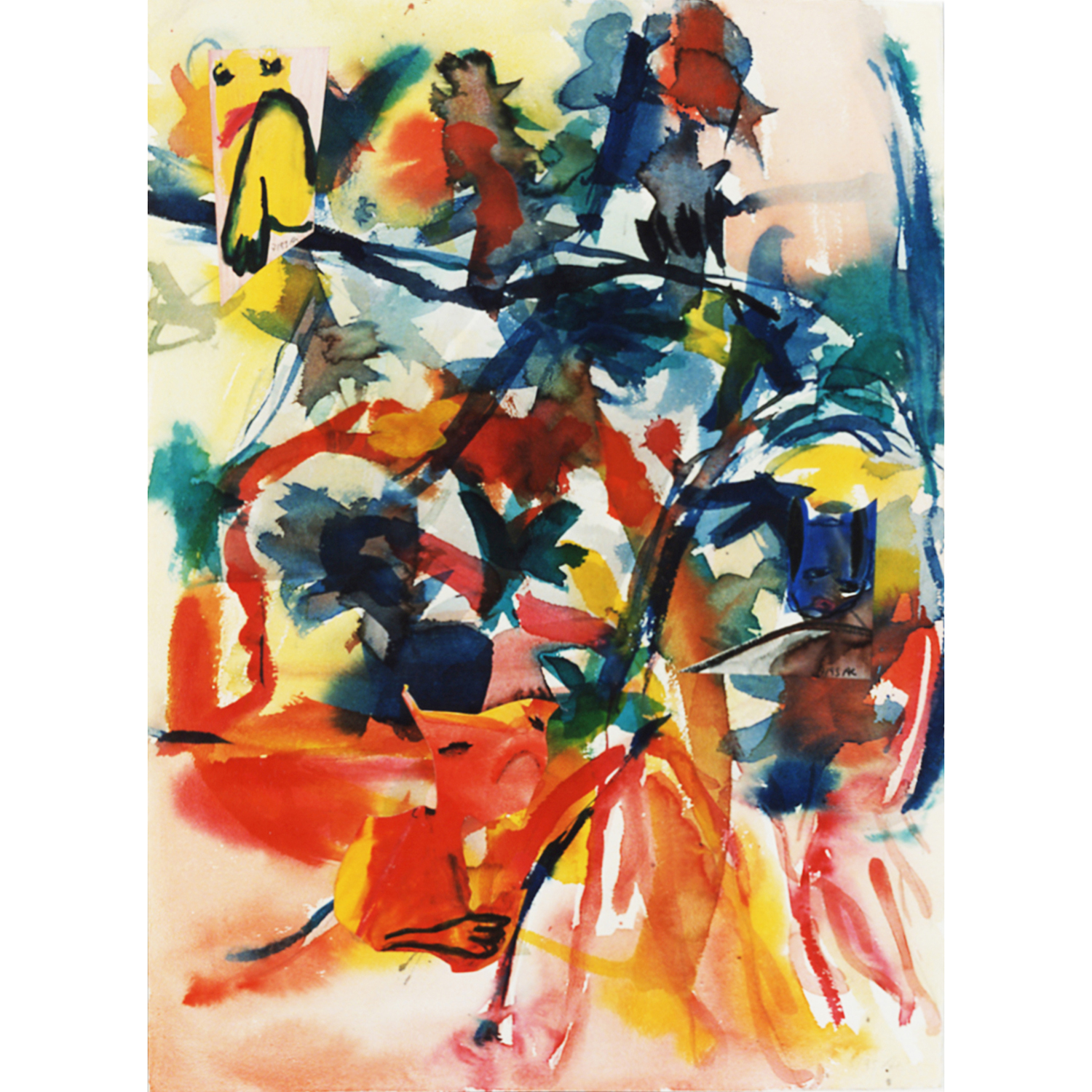
Watercolor, 50 cm x 53 cm, 1995, unframed
Demons are everywhere III (Lantern Festival)
A small watercolor that enlivens and enriches any room.
Whether in living rooms as a series, in the entrance area or in the small office, it fits everywhere and brings joie de vivre.
A small pastel painting that enlivens and enriches any space.
WATER COLOR
Watercolor paints are fine pigments, water-soluble binding agents such as gum arabic and humectants.
They are painted on moistened watercolour paper, a highly absorbent paper, to achieve gradients or on dry paper to achieve clear contours.
White is not included in the colour range. This is achieved by releasing the paper.
The drying process is short, therefore many painters use watercolors for sketches and studies.
Here are a few of my favourites in watercolor painting:
- Albrecht Dürer (1471 – 1528) was one of the first to make the watercolor painting an independent existence. However, his watercolors are partly painted with white, so that one should rather speak of mixed technique.
- William Turner (1775 – 1851) is one of the best known artists of watercolor painting.
- August Macke (1887-1914) brought the luminosity of watercolors in his paintings to a climax during a journey through North Africa (Tunisia).
- Paul Cézanne (1839-1906) painted a series of famous still lifes in watercolors, which created a new pictorial language through intensive examination of impressionistic forms of expression.
My watercolors are mixed with pigments like the acrylic colours themselves. This increases the brilliance of the colours.
The watercolor Paintings are not classic, but a free mix in which also drawing may appear.
Please note that the colors displayed may differ from the original colors depending on the screen settings on your monitor.
About my work
My painting arises from an interplay of construction and removal. Acrylic, pigments, collage fragments: layers are applied, pushed, removed. What remains are traces and breaks that ignite the images.
Figures emerge—often masked, sometimes only as gestures—and move between intimacy and abstraction. I am interested in how identity is formed from layers: from roles, protection, memory. That is why I work visibly: edges, overpainting, and the removal of paint are part of the image’s memory.
My background in engineering shapes my precision, not my vocabulary. I seek precise blurring: places where something is both solid and fragile at the same time.
In this way, the works become spaces for conversation. They do not explain anything, but open up possibilities: those who look compose along with them—with their own gaze, their own biography.
Biography
Annette Kunow (*1953, Berlin) is a painter based in Bochum, Germany. Trained originally as an engineer, she later developed her artistic practice through studies with artists such as Elvira Bach, Franz Hitzler, Nancy Spero and Leon Golub.
Her paintings combine layering, collage and overpainting. Figures appear between mask, closeness and abstraction, creating poetic spaces in which form and transformation remain in constant tension.
Aquarell, 50 cm x 53 cm, 1995, ungerahmt
Dämonen sind überall III (Lampionfest)
Ein kleines Aquarell, die jeden Raum belebt und bereichert.
Ob in Wohnräumen als Serie, im Eingangsbereich oder im kleinen Büro, es passt überall hin und bringt Lebensfreude.
Aquarell
Aquarellfarben sind feine Pigmente, wasserlösliches Bindemittel wie Gummi arabicum und Feuchthaltemitteln.
Gemalt wird auf angefeuchtetem Aquarellpapier, ein hochsaugendes Papier, um Verläufe zu erzielen oder auf trockenem Papier, um klare Konturen zu erzielen.
Weiß ist in der Farbpalette nicht enthalten. Das wird durch Freilassen des Papiers erzeugt.
Der Trockungsprozess ist kurz, deshalb nutzen viele Maler Aquarelle für Skizzen und Studien.
Hier ein paar meiner Favoriten in der Aquarellmalerei:
- Albrecht Dürer (1471 – 1528) war einer der ersten, die das Aquarellbild zu einem eigenständigen Dasein führte. Seine Aquarelle sind allerdings teilweise mit Weiß gemalt, so dass man eher von Mischtechnik sprechen müsste.
- William Turner (1775 – 1851) ist einer de bekanntesten Künstler der Aquarellmalerei. Seine Aquarelle nutzen die Aquarelltechnik für eine atmosphärische Stimmung.
- August Macke (1887–1914) hat die Leuchtkraft der Aquarellfarben in seinen Bildern während einer Reise durch Nordafrika (Tunesien) auf einen Höhepunkt getrieben.
- Paul Cézanne ( 1839 -1906) hat eine Reihe berühmter Aquarelle-Stillleben gemalt, die durch intensive Auseinandersetzung mit impressionistischen Ausdrucksformen zu einer neuen Bildsprache erschuf.
Meine Aquarellfarben mische ich wie die Acrylfarben mit Pigmenten selbst. Das erhöht die Brillanz der Farben.
Die Aquarellbilder sind nicht klassisch, sondern ein freier Mix, in dem auch Zeichnung auftauchen darf.
Bitte beachten, dass die angezeigten Farben je nach Bildschirmeinstellung auf Ihrem Monitor von den Originalfarben abweichen können.
Über meine Arbeiten
Meine Malerei entsteht aus einem Wechselspiel von Aufbau und Rücknahme. Acryl, Pigmente, Collagefragmente: Schichten werden gesetzt, geschoben, abgetragen. Was bleibt, sind Spuren und Brüche, an denen sich die Bilder entzünden.
Figuren tauchen auf – oft maskiert, manchmal nur als Geste – und bewegen sich zwischen Intimität und Abstraktion. Mich beschäftigt, wie sich Identität aus Layern bildet: aus Rollen, Schutz, Erinnerung. Darum arbeite ich sichtbar: Kanten, Übermalungen und das Herauslösen von Farbe gehören zum Bildgedächtnis.
Die Herkunft aus dem Ingenieurwesen prägt meine Genauigkeit, nicht mein Vokabular. Ich suche präzise Unschärfen: Orte, an denen etwas gleichzeitig fest und fragil ist.
So werden die Arbeiten zu Gesprächsräumen. Sie erklären nichts, sondern eröffnen Möglichkeiten: Wer schaut, komponiert mit – mit eigenem Blick, eigener Biografie.
Biografie
Annette Kunow (*1953, Berlin) ist eine in Bochum lebende Malerin. Ursprünglich als Ingenieurin ausgebildet, entwickelte sie später ihre künstlerische Praxis durch das Studium bei Künstlern wie Elvira Bach, Franz Hitzler, Nancy Spero und Leon Golub.
Ihre Gemälde verbinden Schichttechnik, Collage und Übermalung. Die Figuren bewegen sich zwischen Maske, Konkretheit und Abstraktion und schaffen poetische Räume, in denen Form und Verwandlung in ständiger Spannung zueinander stehen.