german version below
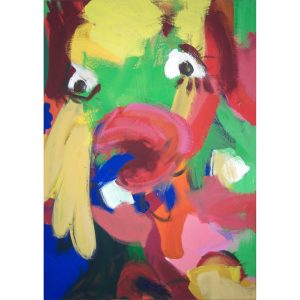
Acrylic paint, pigment on canvas, 40 cm x 40 cm, 2009, unframed, but painted on the sides
Yellow Head I
The artwork “Yellow Head I ” (acrylic dispersion with pigment, 40 x 40 cm) shows an expressively designed head in bright yellow tones. The compact size and the intense choice of colors give the picture a haunting effect, while the texture of the acrylic dispersion lends the work depth and vibrancy.
The contours of the face are kept abstract, leaving the expression open to interpretation – a face that seems to express emotions such as thoughtfulness or a quiet presence.
The yellow hue radiates warmth, while the pigments highlight the structure and give the work a tangible vibrancy. This painting invites the viewer to explore the character and mood of the “Yellow Head”.
Acrylic Paints
The acrylic paintings are painted with pure pigments. A synthetic resin binder, the acrylic dispersion, is added to a water-pigment mixture.
The amount of acrylic dispersion can control the surface of the painting, either a glossy or a matt acrylic painting.
Depending on the addition of water, the colour can be processed like an oil paint or a watercolour.
The amount of pigment creates a smooth or pastel surface.
After drying, the acrylic paint is waterproof.
I particularly appreciate the surface structure of the acrylic paintings, which, due to the composition of the paint, can sometimes be smooth, sometimes shiny or shiny, sometimes matt.
Due to the pigments, the colors appear radiant and reflective in the light. The images then appear as if illuminated.
I learned this kind of colour production with synthetic resin binder from the artist Elvira Bach in a workshop.
I paint on primed cardboard or primed canvas, which I always prepare myself.
I’ve been mixing all the colors for painting myself ever since.
Pigments
Pigments (Latin pigmentum for “color”, “makeup”) are colorants, i.e. color-providing substances. Unlike dyes, they are practically insoluble in the application medium, where they exist as solid particles. The application medium usually encloses the pigments on all sides. /Wikipedia/
Acrylic Dispersion
Acrylic dispersion binder is a milky-looking binder with a creamy, thick consistency. It dries transparent and can also be used for the production of acrylic paints or for transparent priming of canvases. /Boesner/
Please note that the colors displayed may differ from the original colors depending on the screen settings on your monitor.
About my work
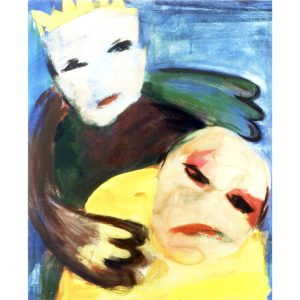
My painting arises from an interplay of construction and removal. Acrylic, pigments, collage fragments: layers are applied, pushed, removed. What remains are traces and breaks that ignite the images.
Figures emerge—often masked, sometimes only as gestures—and move between intimacy and abstraction. I am interested in how identity is formed from layers: from roles, protection, memory. That is why I work visibly: edges, overpainting, and the removal of paint are part of the image’s memory.
My background in engineering shapes my precision, not my vocabulary. I seek precise blurring: places where something is both solid and fragile at the same time.
In this way, the works become spaces for conversation. They do not explain anything, but open up possibilities: those who look compose along with them—with their own gaze, their own biography.
Biography
Annette Kunow (*1953, Berlin) is a painter based in Bochum, Germany. Trained originally as an engineer, she later developed her artistic practice through studies with artists such as Elvira Bach, Franz Hitzler, Nancy Spero and Leon Golub.
Her paintings combine layering, collage and overpainting. Figures appear between mask, closeness and abstraction, creating poetic spaces in which form and transformation remain in constant tension.
Acryl Bild, Pigment auf Leinwand, 40 cm x 40 cm, 2009, unframed, aber an den Seiten bemalt
Gelber Kopf I
Das Kunstwerk “Gelber Kopf I” (Acryldispersion mit Pigment, 40 x 40 cm) zeigt einen expressiv gestalteten Kopf in leuchtenden Gelbtönen. Die kompakte Größe und die intensive Farbwahl lassen das Bild eindringlich wirken, während die Textur der Acryldispersion dem Werk Tiefe und Lebendigkeit verleiht.
Die Konturen des Gesichts sind abstrakt gehalten, wodurch der Ausdruck offen für Interpretation bleibt – ein Gesicht, das Emotionen wie Nachdenklichkeit oder eine stille Präsenz auszudrücken scheint.
Der gelbe Farbton strahlt Wärme aus, während die Pigmente die Struktur hervorheben und dem Werk eine greifbare Lebendigkeit verleihen. Dieses Bild lädt den Betrachter ein, den Charakter und die Stimmung des “Gelben Kopfes” zu erforschen.
Acryl Bilder
Die Acrylbilder werden mit reinen Pigmenten gemalt. Zu einen Wasser-Pigment-Gemisch wird ein Kunstharz-Binder hinzugefügt, die Acryl-Dispersion.
Durch die Menge der Acryl-Dispersion kann die Oberfläche der Farbe gesteuert werden, entweder eine glänzende oder eine matte Acrylfarbe.
Je nach Wasserzugabe kann die Farbe wie eine Ölfarbe pastos oder wie eine Aquarellfarbe verarbeitet werden.
Durch die Menge des Pigments entsteht eine glatte oder pastellartige Oberfläche.
Nach dem Trocknen ist die Acrylfarbe wasserfest.
Ich schätze besonders die Oberflächenstruktur der Acrylbilder, die durch die Zusammensetzung der Farbe mal glatt, mal schrundig oder mal glänzend, mal matt sein kann.
Durch die Pigmente erscheinen die Farben im Licht strahlend und reflektierend. Die Bilder erscheinen dann wie erleuchtet.
Gelernt habe ich diese Art der Farbherstellung mit Kunstharz-Binder von der Künstlerin Elvira Bach in einem Workshop.
Ich male auf grundiertem Karton oder grundierter Leinwand, die ich immer selbst vorbereite.
Seither mische ich alle Farben zum Malen selbst.
Pigmente
Acryl Dispersion
Kunstharz-Dispersionsbinder ist ein milchig aussehender Binder mit cremiger, dickflüssiger Konsistenz. Er trocknet transparent auf und kann auch zur Herstellung von Acrylbildern (acrylic paints) oder zum transparenten Grundieren von Leinwänden verwendet werden. /Boesner/
Bitte beachten, dass die angezeigten Farben je nach Bildschirmeinstellung auf Ihrem Monitor von den Originalfarben abweichen können.
Über meine Arbeiten
Meine Malerei entsteht aus einem Wechselspiel von Aufbau und Rücknahme. Acryl, Pigmente, Collagefragmente: Schichten werden gesetzt, geschoben, abgetragen. Was bleibt, sind Spuren und Brüche, an denen sich die Bilder entzünden.
Figuren tauchen auf – oft maskiert, manchmal nur als Geste – und bewegen sich zwischen Intimität und Abstraktion. Mich beschäftigt, wie sich Identität aus Layern bildet: aus Rollen, Schutz, Erinnerung. Darum arbeite ich sichtbar: Kanten, Übermalungen und das Herauslösen von Farbe gehören zum Bildgedächtnis.
Die Herkunft aus dem Ingenieurwesen prägt meine Genauigkeit, nicht mein Vokabular. Ich suche präzise Unschärfen: Orte, an denen etwas gleichzeitig fest und fragil ist.
So werden die Arbeiten zu Gesprächsräumen. Sie erklären nichts, sondern eröffnen Möglichkeiten: Wer schaut, komponiert mit – mit eigenem Blick, eigener Biografie.
Biografie
Annette Kunow (*1953, Berlin) ist eine in Bochum lebende Malerin. Ursprünglich als Ingenieurin ausgebildet, entwickelte sie später ihre künstlerische Praxis durch das Studium bei Künstlern wie Elvira Bach, Franz Hitzler, Nancy Spero und Leon Golub.
Ihre Gemälde verbinden Schichttechnik, Collage und Übermalung. Die Figuren bewegen sich zwischen Maske, Konkretheit und Abstraktion und schaffen poetische Räume, in denen Form und Verwandlung in ständiger Spannung zueinander stehen.